|
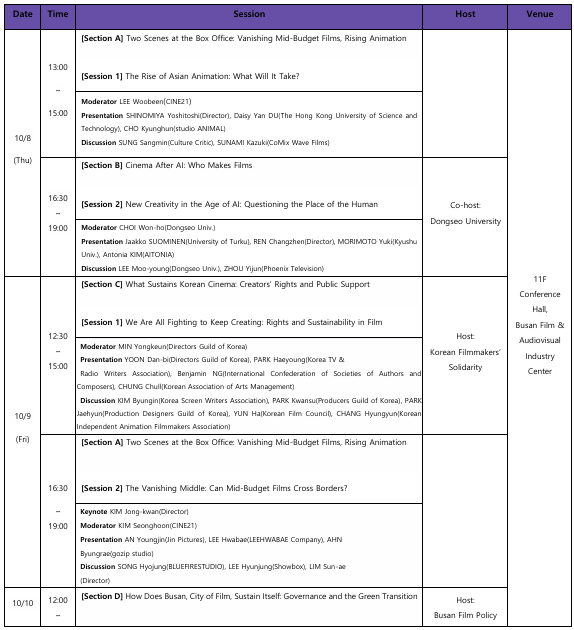
■ Section A. Two Scenes at the Box Office: Vanishing Mid-Budget Films, Rising Animation
Section A, opened by a keynote from director KIM Jong-kwan, looks at two contrasting trends crossing paths in a theatrical market where the downturn continues. ‘The Vanishing Middle: Can Mid-Budget Films Cross Borders?’ traces why the mid-budget films that long served as the industrial ‘middle’ of Korean cinema are disappearing, and explores international co-production as a possible way forward. Participants include AHN Byungrae, CEO of gozip studio, which took part in producing director July Jung's new film Dora; LEE Hyunjung of the Movie Business Division at Showbox; and director LIM Sun-ae of An Old Lady, among others. ‘The Rise of Asian Animation: What Will It Take?’ then examines the current state of Asian animation, has recently emerged as a significant box-office driver, and explores what it will take to turn this rise into sustainable growth. The session brings together director SHINOMIYA Yoshitoshi, whose A NEW DAWN was selected for the Competition of the Berlin International Film Festival; Daisy Yan DU, Associate Professor at The Hong Kong University of Science and Technology; and SUNAMI Kazuki, Managing Director of CoMix Wave Films, among others.
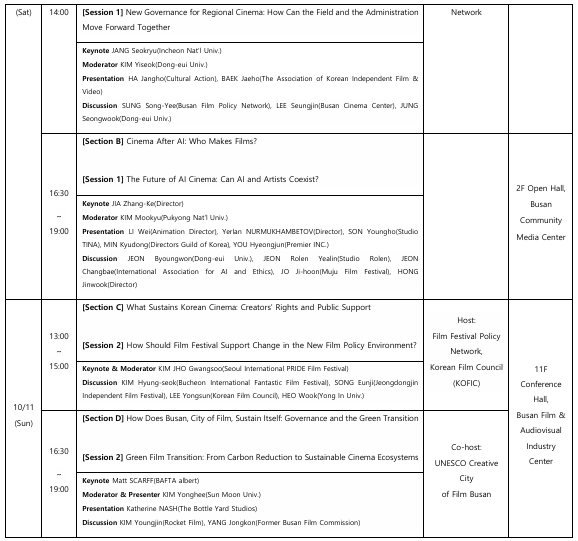
■ Section B. Cinema After AI: Who Makes Films?
Section B asks who makes films, and what role remains for the artist, in an age when generative AI is spreading across every stage of filmmaking. ‘The Future of AI Cinema: Can AI and Artists Coexist?’ opens with a keynote by director JIA Zhang-Ke, followed by presentations from LI Wei, director of the Chinese animated hit Jiang Ziya; Yerlan NURMUKHAMBETOV, director of The Horse Thieves. Roads of Time, the opening film of the 24th Busan International Film Festival; and MIN Kyu-dong, President of the Directors Guild of Korea (DGK), among others, who together survey the changes AI has brought to the production environment and to cinema as a medium. Held in the Open Hall of the Busan Community Media Center, a venue equipped for screenings, the session will also present the presenters’ AI works in full or in clips: Jia Zhang-Ke’s AI-made short Jia Zhangke's Dance in its entirety, LI Wei’s Born of the Tide, and In Winter, Yerlan NURMUKHAMBETOV’s AI-assisted film selected for the 31st Busan International Film Festival made with the use of AI technology, offering audiences a chance to see for themselves, on screen, where cinema stands in the age of AI. ‘New Creativity in the Age of AI: Questioning the Place of the Human’, presented by Dongseo University, brings together perspectives from AI filmmaking, media design, documentary, and digital culture to ask anew what creativity means and where the human belongs. Participants include Jaakko SUOMINEN, Professor at the University of Turku; REN Changzhen, director of the documentary A Bite of China; and Antonia KIM, CEO of AITONIA, among others.
■ Section C. What Sustains Korean Cinema: Creators’ Rights and Public Support
Section C turns to two pillars that sustain Korean cinema: the rights of filmmakers and public support for film festivals. ‘We Are All Fighting to Keep Creating: Rights and Sustainability in Film’, hosted by the Korean Filmmakers' Solidarity, examines the institutional tasks required to sustain creative work, from fair contracts and compensation to copyright, through the voices of working filmmakers. Participants include director YOON Dan-bi of Moving On and The World Before, screenwriter PARK Haeyoung of My Mister and My Liberation Notes, with director MIN Yongkeun of Soulmate serving as moderator. Organized by the Film Festival Policy Network together with the Korean Film Council (KOFIC), ‘How Should Film Festival Support Change in the New Film Policy Environment?’examines the future direction of film festival support amid shifts in Korea’s film policy landscape. Looking back on the sharp cuts to festival funding in 2024 and the recovery that followed, the session considers the role film festivals should play and the principles that should guide future support. It also explores how the needs of the field can be reflected in policy and what changes to support and evaluation systems could be introduced from 2027 onward.
|