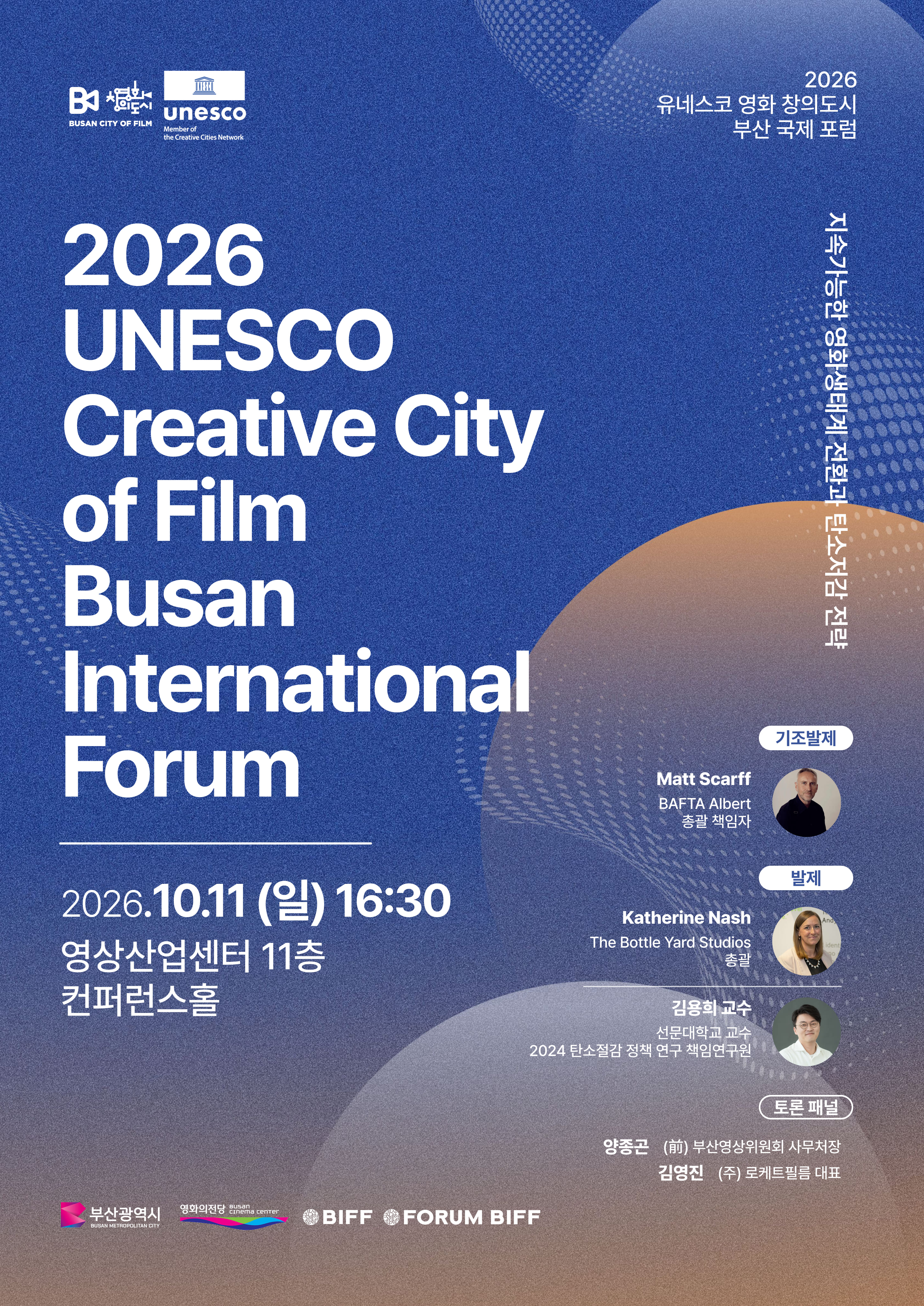
Held during the 31st Busan International Film Festival, this year’s forum will explore the role of cities in building a sustainable film ecosystem through the green transformation of the film industry, under the theme “Green Film Transition: From Carbon Reduction to Sustainable Cinema Ecosystems.” As a Coordinator of UNESCO Creative City Film Subnetwork, Busan will continue this discussion by examining practical approaches to sustainability within the film industry.
The forum will feature keynote presentations, international and domestic case studies, and a panel discussion, bringing together film industry experts from abroad and Korea to examine the goal of building a sustainable film ecosystem from multi angles. The program will focus on ▲Global Policy Trends ▲International City-level Case Studies ▲Domestic Industry Trends, ▲Panel Discussion highlighting current changes in the film industry exploring potential pathways for future action.
The Keynote presentation will offer a global perspective on sustainability in the film industry, featuring Matt Scarff, Managing Director at BAFTA Albert in the UK. Under the theme “International Policy and Industry Trends,” Scarff will introduce key sustainability policies and developments shaping the global film industry.
The city-level international case study will feature Katherine Nash, Head of The Bottle Yard Studios in Bristol, a member of the UNESCO Creative Cities Network. She will share practical examples of how green policies are being implemented in both the film industry and the city of Bristol. The domestic case study will be presented by Professor Kim Yong-Hee of Sunmoon University, who has participated in research on carbon reduction policies for film production in Korea. He will examine current policy trends and developments in the Korean film industry.
The final panel discussion will bring together the forum’s speakers, Yang Jongkon, Managing Director of the Busan Film Commission, and Kim Young-Jin, CEO and film producer of Rocket Film. Centered on the question, “Can Cities Lead the Green Transition of the Film Industry?”, the panel will discuss practical approaches to building a sustainable ecosystem suited to Korea’s film industry, encompassing policy, industry, cities, and film production.
Since being elected Coordinator City of the Film sector of the UNESCO Creative Cities Network in July 2024, Busan has continued to strengthen exchanges and cooperation with film cities around the world. The ‘UNESCO Creative City of Film Busan International Forum’ aims to contribute to the implementation of UNESCO’s Sustainable Development Goals (SDGs) 2030 Agenda, while moving forward toward a more inclusive and sustainable future that embraces film and audiovisual culture, citizens, and the city as a whole.
Cho You-Jang, Director General of Culture Bureau of Busan Metropolitan City, said, “Through this international forum, we expect Busan, as a UNESCO Creative City of Film, to take the lead in building a collaborative framework among policymakers, cities, and industry stakeholders, and to present meaningful pathways toward a more sustainable film ecosystem through practical action across the wider industry.”